YJ-15 Eagle Strike
Tactical Supersonic Anti-Ship Cruise Missile
This section provides a top-level overview of the YJ-15 missile, officially unveiled at the September 3, 2025 military parade in Beijing. Serving as a high-speed tactical workhorse, it balances proven liquid sub-combustion ramjet propulsion with a scaled-down, mass-producible 1.5-tonne airframe. Optimized for carrier-borne operations, it offers an affordable and highly sustainable solution to deliver saturation attacks against modern layered naval air defenses.
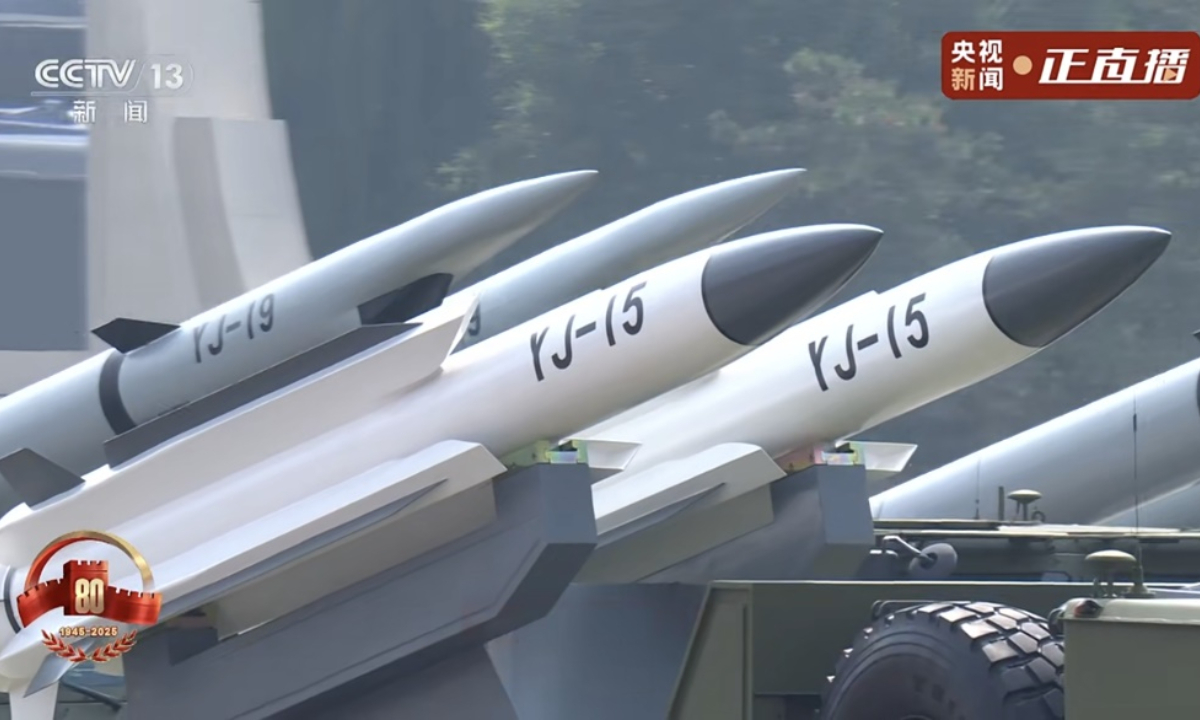
TYPE
Supersonic Cruise Missile
CRUISE SPEED
Mach 3.0 - 4.0
(Realistic Cruise)AIR-LAUNCHED RANGE
600 - 800 km
(Realistic Estimate)PRIMARY PLATFORM
J-15T / J-16 / DDG-138
Simulated Flight Profile
The YJ-15 utilizes an integrated propulsion layout to maximize mid-course efficiency and terminal survivability. Hover over each stage below to learn more about its operation.
Technical Specifications
This section lists the performance metrics and structural details verified by cross-referencing domestic operational data with contemporary defense findings, clearing up historical designation confusion regarding turbojet propulsion and inaccurate entry dates.
Database Correction Note:
Western claims estimating hypersonic speeds (Mach 5+) and 1,800 km ranges for the air-launched configuration are considered physically improbable due to thermal loading limits and airframe fuel capacities. Conversely, old entries citing a 2015 introduction or turbojet configurations are entirely erroneous tracking mistakes.
Multi-Platform Integration
The PLAN optimizes fleet commonality by distributing the YJ-15 across carrier air wings and modernized surface fleets, enabling flexible standoff execution.
Carrier-Borne Tactical Aviation
The compact 1.5-tonne launch weight allows the weapon to be securely fielded by the Shenyang J-15T catapult-capable multirole fighter from electromagnetic catapult systems like the carrier Fujian. Structural enhancements to the missile body safely sustain high longitudinal stress during catapult deployment.
Standard configurations feature two underwing YJ-15 missiles alongside PL-10 close-range missiles for defense. Enhanced strike configurations supported by J-35 escort fighters can increase this loadout up to four underwing YJ-15 units per sortie. It is also integrated onto land-based J-16 tactical multirole fighters.
Modernization of Legacy SurfaceCombatants
The YJ-15A variant updates older surface hulls effectively. In April 2026, the modernized Project 956EM Sovremenny-class destroyer Taizhou (DDG-138) demonstrated that old Russian KT-190 launcher assemblies had been completely retrofitted with domestic launcher canisters housing the YJ-15A weapon system.
The vessel utilizes a completely modernized domestic tracking suite: two quadruple YJ-15A launchers, a 48-cell HQ-16 VLS, Type 1130 CIWS, HHQ-10 systems, and a Type 382 3D search radar linked to X-band phased-array fire control radars. Ship-launched canisters accommodate a larger solid booster, allowing a high-altitude semi-ballistic cruise to extend the range to an unverified 1,500 km.
Strategic Analysis
The tactical incorporation of the YJ-15 reshapes maritime power dynamics across the Western Pacific by diversifying attack vectors and optimizing economic output.
Decentralization of High-Speed Strike Assets
Historically, supersonic strikes depended on heavy, easily visible land-based H-6K/J bombers carrying massive YJ-12 units. By integrating the compact YJ-15 onto agile tactical carrier fighters like the J-15T, the PLAN can carry out low-altitude ingress approaches from unexpected, distributed angles, compressing defensive alert windows significantly.
Comparative Analysis
This section visualizes how the YJ-15 tactical variant compares against related air-breathing options and specialized anti-ship assets deployed in contemporary environments.